Friday, May 20, 2016

World IBD Awareness Day

This is not my normal type of post, but today is World IBD Awareness Day. So I'm going to make you all aware. A lot of this is very personal and typically considered TMI in society, but whatever. I've been pretty open already because it has affected my life and training so much. Most of the information here is what I've read over the past year and my own personal experiences. There is a lot of good information at www.ccfa.org, Please bear in mind, this is a blog, not a lit review or scientific paper.

IBD stands for Inflammatory Bowel Disease, which includes Crohn's Disease and Ulcerative Colitis. IBD is essentially an auto-immune disease in the gut that is caused by a combination of factors including genetics, environment, and microbiota in the gut. The exact cause is unknown. The two diseases differ in that Chron's can affect the entire gastrointestinal tract, but Ulcerative Colitis is found in the colon and rectum. These disease are quite serious. It's not just "going to the bathroom" more than normal. If left untreated, it can be fatal. The symptoms can range in severity, and people have different responses to treatment, so experiences with the disease may be very different.

My symptoms began in January 2015 (although there were some issues a few months before that that resolved and I chalked it up to a stomach bug...). I was going to the bathroom way too many times and not having normal, formed stool. I assumed it was stress because of crazy school things that I'm not going into detail in, so I ignored it for a month. When I started noticing occasional blood, that's when I knew I had to go get it checked out. I saw my PA, who was great. She ran through a bunch of tests (celiac, parasites, communicable GI diseases, and an occult blood test). Everything was negative except the occult blood. So I repeated that and it was again positive. She immediately got me a referral to a gastroenterologist. During this time, I started experiencing cramping, but it seemed to be directly correlated with the intensity of my workouts. I had to stop several times when the pain got bad. Even during our trip to Disneyland, the pain was increasing and we were just going from one bathroom to the next in between rides. I had a colonoscopy and was diagnosed with Ulcerative colitis.

So I've pretty much shared how my triathlon season was affected by this already. The month before Nationals, I was really sick, but I kept trying to convince myself that I was fine. We had already been trying anti-inflammatory medications (mesalamine) in various forms (enema, suppository, oral) with zero improvement. Symptomatically I was getting worse. We tried a couple doses of Prednisone and Flagyl (that stuff is horrid) to no avail. I was bleeding a lot and going to the bathroom a lot and the pain was unbearable most of the time (my parents took me to the ER 3 times before I moved). I kept trying to train and convince myself that I was fine. I wanted to go to Nationals. I wasn't fine, and deep down, I knew it. The week before Nationals, we decided to try IV steroids, which meant staying in the hospital. I was devastated.

I still wasn't improving, so we went tried a biologic, Simponi (this one is a TNFalpha blocker). Two months after the hospital stay, I was still getting worse and began vomiting a lot. This led to more ER visits. I had C. diff. Apparently Ulcerative Colitis makes you more prone to C. diff. That plus hospitals and steroids are like the perfect storm. Still no improvement, so we tried a different biologic. C. diff. is a terrible bacteria that us becoming increasingly antibiotic resistant. For me, it caused nausea and pain so severe that I wished I were dead.

And then, C. diff again. I knew right away when I almost passed out in the shower after vomiting a lot at school. I was in so much pain I crawled to bed and my parents made me call an ambulance. No one even believed me (except my parents) when I said it felt like the last time I had C. diff. I ended up going to the ER twice the week before practicals and tests at the end of the semester. My GI put me on antibiotics pretty much right away just in case while we awaited results (another positive). It took a month to start to feel better. I got a rescue cat, Briar Rose, but she really rescued me. She knows when I don't feel well. She's a snuggler. A few months later, I had C. diff for a third time. My dad put the camping mattress in the bathroom for me to sleep on with my cat.

We made the decision to do a fecal transplant to prevent C. diff from coming back. I had to drive all the way to Reno from Sacramento (and mommy had to drive me the day of the procedure). The good news is, I feel so much better already. The bad news is, a lot of my symptoms are still there. The pain has reduced to just occasional cramping rather than lying on the floor curled up in a ball. So I'm thankful for that. I've also been able to start training more and even worked up to a 50 mile bike ride! But the reality is, with symptoms still having a major negative impact, that means that the current biologic treatment has not been successful, so now we have to try something else. I'm going to take the victories that I can, and I'm planning on racing next month at Folsom International and/or Tri for Real #2. After all that has happened, I know that I'm not as fast as I used to be. Speed isn't the point triathlon. Accomplishing new goals is the point. And having fun. That's always the point.

Oh and of course, IBD doesn't just affect the patient. It affects family. It affects friends. It affects everyone. So thank you to everyone who has been supportive. Especially to my parents who have been there every step of the way.

Now you're all aware.

Sunday, March 6, 2016

This hill is steeper than it used to be

Those were my thoughts as I was climbing one of the hills on the River Mountain Trail. No one else was around. Not even a roadrunner was in sight in the surrounding dusty hills.  From the empty parking lot, there was not much of a warm-up before hitting the hill. My lungs were already burning and my heart was pounding only five minutes into my ride as I started to climb. The last time I had been on this trail was at the end of July as I was preparing for Nationals. I was at least thankful for the 70 degree January day as opposed to the 110 degree July heat.

Last year, after not being able to go to Nationals, I kept thinking I would be able to race at Silverman 70.3 and salvage my season. That turned out to not be a possibility. After weeks of nausea, vomiting, and a lost appetite I found out that I had C. diff (which is apparently common with UC, especially with the treatments I've been on). My parents took turns coming to take care of me and trying to get me to school as much as possible. I had to let the season go. When I eventually got over that, I ended up having a relapse a month later and was basically knocked out the rest of the year when I wanted nothing more than to start off-season strength training. Even walking around the block was a challenge.

Starting to train from nothing is a lot harder than staying in shape and keeping up with a routine (remember that if you are falling off the wagon). I have fallen so far from where I was. Every time I think about what I'm not able to do it's hard not to cry. When I swim, it is difficult to hold back tears, but I don't want to fog up my goggles. I'm frustrated that I'm not where I used to be and worried about the unknown. I need to focus on climbing back up, not on falling down. I need to congratulate myself each time I make it a little further, or a little faster. Personally, I like to celebrate with cookies. And I still reward myself with a quarter in my Kona jar because every workout counts.

The trick to starting a new workout routine, or coming back from illness or injury is really learning how to balance everything. You need to push yourself while not overdoing it. My very first workout this year was an 18 minute swim. I was tired after the first few minutes, but I was able to keep pushing. I was done at 18. There is a difference between "tired" and "done" and "oh no, I did too much." Each time you can make it to "done," you know that you are getting stronger and faster, and your endurance is building. Every time your workouts improve, you should acknowledge it. Be proud of what you can do and how far you've come. Eventually, you will get to where you want to be.

I have had to make a lot of adjustments, which is not an easy task for someone who likes to plan everything. Coach told me last season that it is okay to deviate from my schedule. Go hard on the days that you can, and take it easier when your body is telling you to. There are still a lot of unknowns. I'm going to do what I can, and that's really all that I can ask of myself.

Sunday, September 13, 2015

Starting Over

I know it has been a long time since my last post. I have not fallen off the face of the earth. I'm still around. I have had to take some time off from triathlon due to ulcerative colitis (in case you didn't read the last post). I've already committed to sharing the good, bad and ugly of my triathlon adventure, but I will spare the messy details. You're welcome.

I guess the good thing about having my season so rudely interrupted is that it's so hot in Henderson, NV (yes, I moved) that the triathlon season is just now starting.  As long as I can get healthy, I can have a do-over for 2015 and squeeze in a couple races.


One of the most important things that you have to remember is that you have to take care of your body. Triathlon is great exercise and it's a lot of fun. But there may come a time when you need to stop and take a break. Your health comes first. Knowing when to call it isn't easy, but you need to be safe and healthy.

I spent the summer training as much as I possibly could for Nationals and Silverman 70.3. My summer training did not go as planned. I could not put in the volume or the effort that I would normally spend on training. The pain was getting worse and I had no idea how many calories I was actually absorbing. I had to learn to re-plan my workouts, which is really hard for someone like me who likes to schedule and plan everything. If I had a good day, I would train hard. If I was too sick, I either did a lighter training session, or had to take the day off. It was difficult mentally to cut a workout short. I had to learn to focus on the success of the workouts that I was able to complete and try to let go of the ones that I could not.

I was really excited for the Tri for Real series since I have made huge improvements over the past few years. I was coming off of a good race in Auburn that built my confidence, and I really wanted to PR. I was not well the day before, but I tried to convince myself that I could race anyway. I hadn't kept enough food in the day before or that morning. I knew it was a bad idea to race, but I went out there, and got set up. It was not until my warm-up that I was really honest with myself. I knew at that point that if I started that race, I would not finish. I ended up withdrawing. I cried when I got home, but it was the right decision. The next month, I was able to have a great race at the second Tri for Real, coming in second overall and only 2 minutes off my PR. I was really excited about this comeback, and I couldn't wait to go to Nationals.

Everything came to a screeching halt at the end of July. I was not absorbing enough calories or water no matter how hard I tried. I was down 12 pounds by this point. There were several days where it was a challenge just getting off the couch to go to the bathroom. I didn't want to give up on Nationals, but my good training days were dwindling and I couldn't maintain a healthy weight for triathlon. I was worried that I wasn't going to be able to race, but I wasn't ready to admit it. I was eventually told that I needed to think about getting IV steroids. As an athlete, my first thought was a defiant, "Okay, I'll think about it after Nationals." But the reasonable, future doctor part of the brain kicked in and decided that it was time to stop. My bike was lonely all boxed up and ready to go to Milwaukee, but it had to sit in my living room by itself instead while I went to the hospital to get some steroids.

Now comes the starting over. In my mind, I was still planning on doing Silverman  70.3. I thought I was going to break out of the hospital all ready to go and start training again. It didn't happen quite like that, unfortunately. I'm still not really at a true "starting over" point since I'm still not in remission. I keep thinking I'll just wake up and feel fine again. My alarm clock is set for 5:00 A.M. every day just in case that is the day that it will all go away so I can train as usual. Most of the time it hasn't happened. It's gut wrenching when I realize that I can't workout. I know how hard everyone else is training and I want to be there, too. I want nothing more than to throw on my running shoes and post on Facebook about my amazing brick workout. But it isn't happening. I feel as if I'm lazy or not tough enough, or just full of excuses. What is a triathlete to do without triathlon? Studying Biochemistry at 5:00 in the morning is just a sad way to start the day. My bike isn't the only one feeling lonely.

I'm planning on doing Austin 70.3 with an Olympic distance a couple weeks before. I don't know how the next two months are going to go (it currently it hasn't been good), but I'm planning for the best, and taking it day-by-day. I am going to have to be smart about training by listening to my body and monitoring my food intake more than ever before. Hopefully my do-over will come. Otherwise, there's still next year.

Train smart and have fun. You only have one body. Take care of it. Enjoy the time that you have to do what you love because you don't know if or when things are going to change. Take advantage of the good days.

My parents definitely get a huge thank you for being by my side and taking care of me through all of this. Thank you for all of your love and support.

Tuesday, May 26, 2015

Auburn International Triathlon Race Report

As I mentioned in my last post, I really wanted to get through this race and finish. It is a challenging course. I'm not where I want to be with training because of the recently diagnosed ulcerative colitis. My only goals for this race were to finish and work as hard as I could. I am really happy that I accomplished this. It was a huge mental boost for me to know that I can get through this race, especially considering that just a week before the race I couldn't move because the abdominal pain had been so intense, and the neck injury that I've been dealing with had worsened.

My sister's college graduation ceremony was the day before the race. I wasn't going to miss that for anything. I'm proud of her achievements and wanted to celebrate with her and my family. I ended up getting home way later than we expected, so I only got about 4 hours of sleep. But that's life.

On race morning, I was up at 3:30. The weather forecast was low 70s, which I think is cold, but comfortable enough. I know most people liked the temperature for racing. My dad spent the entire day as my personal support crew, for which I am very thankful. Sorry if some of this is TMI, but I'm sharing anyway. I ended up sleeping in the car on the way up since my meds make me uncomfortable in the morning, and my dad was nice enough to drive. We got to T2 to drop off my shoes, and I was surprised that there weren't more people up there. We drove down to T1 (as close as we could get in the car). I had to change what time I usually eat before the race (I've always eaten an hour before) because lately I have had to go to the bathroom almost exactly an hour after I eat anything. I didn't want to have to deal with that during the race, so I had to eat earlier. I know that seems like a silly thing to think about, but when we have our race day plans set up, we need to be prepared with every little detail, but be adaptable in case anything changes. I didn't have to run during the race, so mission accomplished.

It was awesome seeing so many of my friends getting ready, volunteering, and cheering. Before the race started, my coach told me to smile the whole race. I think this was the most important advice. It helped me not think about the pain and remember why I am out here. I race because it's fun. I enjoy pushing myself as hard as I can during training and racing, getting to the finish line, and reaching my goals.

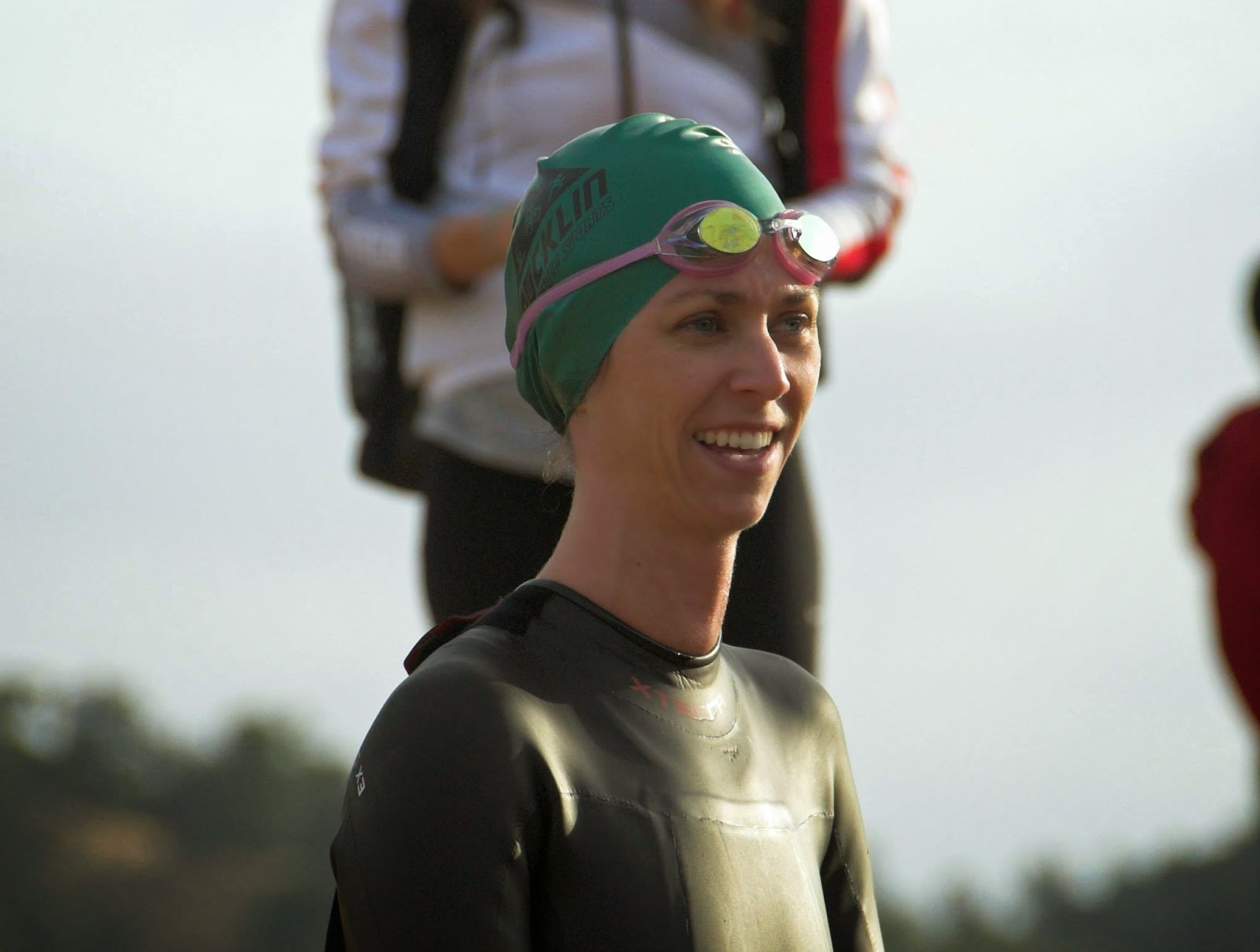
Pre-swim start (Photo credit: Mark Davis)
The swim was interesting to say the least. There were three different distances- World's Toughest Half (WTH), International, and Mini. WTH had the furthest swim at 1.2 miles, so they had yellow buoys to mark their turns. Ours was 1.5K (0.9 miles). We had orange buoys. The swim out was uneventful. The water was perfectly comfortable temperature-wise. I felt as if I had a good pace and was sighting well for the first two buoys. After the second buoy, we were looking straight into the sun. There were no sighting buoys (that was my one criticism of the course if any). I had absolutely no idea where the next buoy was. I swam towards where I thought we were supposed to go. I was alone. I finally saw an orange buoy and started swimming toward it. As I got closer, I realized that it was the start buoy. The Mini race was starting. I could now see the turn buoy way off to my right and turned toward it. The Mini swim course went straight to the buoy that I was now headed toward. Now I had an extra pack of swimmers to go through. As I got to the turn buoy, there was another crowd of the WTH athletes. It was bunched up from there to the end of the swim, but I was able to make it through unscathed and with a decent pace. The abdominal pain started becoming more noticeable about the last turn buoy, but I had to keep going. I thought I had lost a lot of time, but I heard the announcer call out Elsie Winter (They couldn't get Elise's name right haha) right ahead of me. I wasn't the only one who took the scenic swim route. Swim time was 25:31.
Coming out of the water (Facchino Photography)

On the bike (Facchino Photography)
I got on the bike and started heading up the hill. The bike course for the international according to MapMyRide has 2,155 feet of climbing over 40 K. It's not easy. I'm glad I had a couple rides on the bike course because it was a technical course. You really have to know what gear to be in around each corner because every turn is followed by a hill- usually going up. I had everything planned down to when I would take my first Gu (right before Shirland Tract), which is one of the most difficult portions of the course. I saw someone with a dropped chain almost immediately after turning onto this street. There were chalk messages cheering on Jenni (who did WTH) and me on Shirland Tract (Total Intensity Sports peeps rock!). I laughed to myself when I saw "Yum hills" further up the hill.  My dad went all over the bike course to cheer me on. I loved seeing him out there so much with his GoPro and cowbell. I saw the first men coming back a little bit after the aid station. I expected to see the first women several minutes later, but I did not until the last street- a couple minutes before the turn around. I was very relieved that I was not as far behind as I thought. Elise was out in front followed by a few others. Everyone seemed pretty close. I saw Coach John out on the course on my way back, and Mark a little while later. Heading into T2, I misjudged the hill right before transition. I was planning on a flying dismount, but it ended up being so slow and ungraceful that I ended up having to just get off the bike a little before the dismount line. Not one of my better moments, but good for a laugh. My bike time was 1:29:02.

Run Run (Facchino Photography)
I was expecting the 10K run course to be about the same level of difficulty as the run at Rancho Seco as far as elevation and trail difficulty go. There were some technical spots on the trails and a few hills. Nothing crazy, but I wouldn't call it easy. It took my legs about a mile on the run to start feeling good. The next mile or so I felt as if I was having a strong run. There was one section that veered off down a hill to an aid station where I saw Amber and Aimee volunteering and cheering. I'm really glad they were there because I really needed that boost! By about mile 3, the pain was really starting to intensify. It was tough, but I knew that I was going to get through this race. I just focused on my run stride, smile, and getting to the finish line. This is usually when I kick it into the next gear on the run to finish hard, but it wasn't there. I was able to maintain my pace and kept going as hard as I could. Because I did not preview the course, I did not realize that the second loop was shorter than the first loop. It was a very welcome surprise. I was spent when I crossed the finish line. My run time was 51:15. My final race time was 2:49:53, which was good for a 2nd place age group finish and 5th overall.
25-29 F (Photo Credit: Daddy)
Congratulations to all of the athletes who raced this weekend. It's always fun to see everyone out there working hard and having fun. And congratulations to Elise (aka Elsie haha) on an awesome race and the overall win.

Thank you so much to my sponsor Rudy Project for helping make this all possible. This was my first race to try out the Wingspan helmet, and I love it! Thank you also to Coach John Pottebaum and my Total Intensity Sports teammates for getting me ready for this, especially with the extra unexpected challenges. Thank you to all of the volunteers, race staff, and friends who were out there supporting all of the athletes. And of course, thank you to my wonderful parents who have always been supportive of me and for taking care of me.

I am really looking forward to the rest of this season. After finishing this race, I know that I can push through and compete and I'm excited for some PRs. There is no quit. See you all at Tri for Real.

Monday, April 27, 2015

Racing Your Best Doesn't Have to be a PR

It is easy to think about all of the things that are going wrong and to wonder how you're going to be able to continue training and pushing through various problems. It is easy to get caught up in the things that you can't control. I think it is far more difficult, but far more important to focus on the things that you can control. You can't always control your racing conditions. What you can control is your effort. Not every race is going to be a PR. But you should finish every race confident that you did your best with what you had that day. Use your workouts as stepping stones and work as hard as you can when you're doing maximal efforts.

Be confident in the work that you have been able to accomplish. Use that as motivation. Be realistic and get to the finish line knowing that you've done all that you can do. Everyone who is lining up at the start of a race has something to deal with. You may not know what it is, but I can guarantee that everyone around you has had setbacks of some kind.

I ended up having extra stress in the way due to a bad school situation. It was not at all how I planned, and I did end up losing training time over things that were beyond my control. Most of us have other responsibilities (although it would be nice if we didn't), and we need to recognize and take care of priorities. As difficult as it is, sometimes that means we don't get to go to the gym or hit the bike trail as much as we want. But that's all part of life. Do what you can do.

With recent health issues on top of this, I have not been able to train as much as I want. I was recently diagnosed with ulcerative colitis. I have been doing everything I can to train as much as possible. It has not been easy, though. I've missed a lot of training, unfortunately. I haven't been able to eat/absorb as much as I should be, especially for this type of training. I've lost weight. I'm exhausted all the time. I've been in pain. Sometimes my training involves just trying to make it to the next port-a-potty.

I'm not where I want to be three weeks out from the start of the season, but I'm going to get to the finish line. I have thought about pulling out of this race because I know that I won't be my fastest. But that seems like a stupid reason not to do something that I love. Racing is what I enjoy doing. And I am going to go out there and give my all and do the best that I can. If I wait for "perfect" racing conditions, I'm going to miss out on racing with all of the amazing athletes who will be out there.

I do want to take a moment to thank my parents for taking care of me and supporting me. I couldn't do this without their encouragement.

See you in Auburn.

Sunday, February 15, 2015

Bikes

Sorry that it's been so long since my last blog post. Today's topic is all about bikes and bike gear. It is really easy to spend a ton of money on bikes. This is the most expensive leg of a triathlon. Here are all of my thoughts. There are two important factors when considering what gear to go with on the bike: 1) What are your goals? and 2) What is your budget?

The biggest gains on the bike are going to come from off-season training. Strength training, especially during the off-season, is going to be a major component of speed during the race season. I think my coach is great about emphasizing the importance of strength training. Speed sets and hill training throughout the year are also going to provide a huge boost. Or even more fun- speed sets up hills. The major PRs are going to come from training.

With brand new triathletes, I always recommend being conservative with expenses. Don't spend thousands of dollars on a bike until you know that you like the sport. Once you fall in love with the sport, which is easy to do, then you can start spending the money. I think it's important, especially for someone in my position as a student, to balance spending with training and overall goals. Yes, spending more money can save some time here and there in a race. If you are at a point where seconds and minutes are going to make the difference with age-group and overall standings, that is the time to think about extra gear.

I've been slowly building with the bike over the past several years. This was my weakest area for me for most of my triathlon career, but it is now my strength. When I did my very first sprint distance triathlon, I borrowed a bike from one of my dad's friends. I didn't even own a bike at the time. I had so much fun and eventually saved to get a hybrid for other sprint distance races. Prior to my first Olympic distance, I bought my first road bike (a Fuji Roubaix). I even did my first Ironman on my Roubaix. Having a TT bike is better for Olympic and Ironman distances, but the point is, it can be done with spending less. It was at this point that I knew (and my parents knew) that I needed to get a tri bike to start seriously improving. They helped me with my Cannondale Slice, and it has been a major contributing factor to my improvement over the past two years (thank you, parents).

TT bikes are going to not only save time on a race by providing an aerodynamic profile, but they are inherently designed to help save your legs for the run. Spending extra on lighter components is also going to help a bit. Getting an aero helmet is probably going to be the cheapest way to save a little extra time. I borrowed one last year (thank you, Heather!), and I am definitely planning on getting one for this season. I think it would also help to get a good bike fitting (there's a PT in the area who does this) to help maximize efficiency and comfort on the bike. I have not yet done that, but again it is planned for this year. Having race wheels will definitely help with some time, and I'd love to have some, but those are still not in my budget.

I get my bike tuned up about a month before my first race of the year and again if I have another huge race (if there is a lot of time between the first race and big race). This gives enough time to replace any components that need to be replaced, and enough time to make sure that everything still feels good in case any adjustments need to be made. I also clean every inch of my bike the day before each race to get all of the extra gunk of and make sure it is in working order.


Happy riding! And as always, feel free to ask any questions. :)

Monday, December 29, 2014

Time Management

I wish I could train, but I don't have time. How often have we heard that before? How often have we said that before? We all have responsibilities between jobs, school, family, or whatever random chores need to be done. How do we balance it all?

In reality, taking care of our bodies is essential for doing any of those other things well. It is a priority. We will be more successful in whatever we choose to do with our lives if we focus on our health and well-being. Plan time in your day to exercise. Plan time in the 24-hour period for sleep. Both of those are important.

This past semester, between taking care of a neck injury at physical therapy, and a heavy course load, I will admit that I am not training as much as I want to be. School is the number one priority, but I know that I won't be as successful with school if I don't take the time to exercise or take care of the nagging pain. Instead of 3+ hours of training, I will sometimes have to cut training down to 1-2 hours. Your brain is going to wander naturally if you sit and stare at a computer screen or paper all day. Schedule that wandering time and use it in a productive manner. Recharge yourself between tasks. If you don't think you have 1-2 hours, go for a 30 minute run. That's still a good workout.

If you are having difficulties with planning the workouts, make a schedule. It is a lot easier to hold yourself accountable if it's written down. If you are shortening your workout, you can maximize the time by increasing the intensity.

Happy Training!