When I see articles or watch the news about cases of abuse I have a hard time wrapping my head around the fact that often times, other people knew what was happening. People could have stopped it. But they didn’t. Why?
The story that I’m going to tell, while nowhere near as bad as rampant abuse cases that have come to light over the past several years, I believe sheds light on how these things are allowed to happen. It is my own story about an injury that changed the trajectory of my life. Because I want to stop these stories from becoming an accepted part of our society or part of the normal pathway to reaching your career or life aspirations, I am speaking up now. And I encourage all of you to do the same. If you see something, say something.
I know I’m not the first person who has ever been injured by a superior, and I know I’m not the first person who has been harmed at a school by an individual in a position of authority. I did not speak up publicly sooner because I was attempting to go through what I considered to be the proper channels. I trusted my professors and believed that, as medical professionals who were also responsible for my own medical education, that they would do the right thing. I am telling my story now to encourage others to tell their stories and to speak up if you see something that’s not right. In the medical field, especially, you have a moral duty, and in many jurisdictions a legal one, to report ethical violations committed by licensed practitioners.
Here is my story:
Imagine being awakened in the middle of the night by an intense burning pain that feels as if someone took a knife out of hot coals and started stabbing you repeatedly in the foot. That’s what Complex Regional Pain Syndrome (CRPS) feels like. After dealing with so much from the Crohn’s Disease lately and having a total of 9 episodes of c. diff infections, I feel as if I am finally starting to improve on the gastrointestinal front. I am finally starting to exercise again, albeit not what I used to be doing. On several occasions, I have left the gym in tears because after everything I’ve been through with the illness, I still face the reality that I may never be able to run normally again after being injured by a professor in medical school. It’s been over three years, and I have been in pain every day.
I had CRPS several years ago that had completely resolved. In fact, I completed an Ironman in 2012 with no foot pain at all. And I became more competitive at Olympic distance triathlons from 2013-2015, with several age-group and all-around woman podiums and invitations to compete at Nationals. CRPS is usually brought on by an injury. The first time was because of a tarsal coalition (a congenital [present at birth] malformation that typically presents in the teen years). I had surgery when I was 17 and worked hard with physical therapy and training to resolve the condition. I was completely pain free for several years.
In the recent case, the injury that led to the recurrence of CRPS was caused by Dr. Wesley Lockhart, a professor at Touro University Nevada College of Osteopathic Medicine. Dr. Lockhart told me to be the demonstration patient (the person being practiced upon for learning osteopathic manipulations) for our group to learn a manipulation technique of the fibula. But then, without my permission or any prior warning, he did a manipulation (for those in the field- high velocity low amplitude [HVLA]) on my foot that was not what we were supposed to be learning that day. Everyone in my group heard my foot pop. And then came the pain. Because of my history, I never would have allowed anyone to do a manipulation on my foot. I hoped the pain was just a fluke and would resolve, since even normal manipulations can cause temporary pain. I certainly did not want to make trouble for Dr. Lockhart- a physician and professor, whom I trusted. And I did not believe that he set out to injure me intentionally. When the pain did not resolve after about a week, I knew that I would need to seek medical treatment, so I reported the injury to the course director, as we were instructed to do in our syllabus for any injury that occurred in class.
It was soon after I reported the incident that the harassment began. I was cornered by another professor and told that I should not have been in medical school with a history of a foot injury. This statement left me baffled. There has never been any reason that a person with a history of a foot injury would not be eligible for medical school (which had healed years before starting school- I am an Ironman, afterall… Not to mention, that’s just an absurd thing to say regardless). His words turned out to be foreboding, as he was setting the stage for what would become a pattern of intimidation and badgering by professors and administrators. I had already received an e-mail by the director of Office of Academic Services and Institutional Support (OASIS) asking if I was leaving the school soon after reporting the injury. I thought this was absurd since I was doing well in my classes and had good grades. To me, it seemed that their game plan was to do everything they could to chase me out of school rather than right the wrong. Although the course director initially told me that the school was going to pay for the treatment, the dean of student affairs then called me into his office and backtracked, telling me that they would “pay for the initial evaluation but would not make any other promises.”
At this point, things went from bad to worse. The course director had told me that I was not to be the demonstration patient anymore. I felt singled-out and isolated. Because of the course director’s edict, my groups took longer in class because, while we would normally partner off to practice, I was required to be in a group of three to give everyone a chance to practice each technique. For our practicals, we would normally be randomly assigned to demonstrate on another student. For individuals who were not allowed to be the demonstration patient (i.e., if they had an injury to an area that was the focal point of the exam), the syllabus said that we were supposed to bring a surrogate (another student willing to volunteer to be the demonstration patient for our practical). At one of our exams, when I was randomly assigned to the earliest exam time, I had to scramble to find someone willing to arrive early. When I had asked one of my friends, who would have otherwise been willing to go, she told me that she was exempt from being the demonstration patient for that particular type of exam. Unlike me, though they always assigned a partner for her for practicals from which she was exempt from being the demonstration patient. I was being held to different rules than other students.
Maybe it was just coincidental, but I noticed the same pattern from professors that I barely knew. In a subsequent class, when I was told by another professor to be the demonstration patient in my group for manipulations, I responded that I could not, as was the standard protocol. I expected that he would just ask someone else. Instead, the professor berated me in front of my classmates.
Mistakes happen, but it is our choices that reveal our character. While I do not believe the actual injury was intentional, Dr. Lockhart has shown no remorse to me. To this day, Dr. Lockhart has yet to apologize. In my opinion, it is terrifying that someone who chose not to take responsibility for causing physical harm to another human being is not only continuing to practice medicine, but is also still teaching the next generation of physicians. In my opinion, all of the professors and administrators who had knowledge of the incident, or were involved in the aftermath, had a duty to ensure a safe environment, and all failed. Not only did they fail, but they chose to make a bad situation worse. From my prior experience, if someone has demonstrated a willingness to cross the line of morality, it does not only happen once. As the intimidation escalated, I felt unsafe. If I could be injured and so easily tossed aside, what was going to prevent this from happening to me again? Or to one of my classmates? How was this going to impact my career prospects if I continued because I reported a problem? I ultimately made the decision to withdraw from Touro, leaving me with approximately $90K in debt (plus interest) for that school year and ending my medical career.
Once it was made clear to me that Dr. Lockhart and the school were not going to take responsibility for the injury, I felt that I had to get a lawyer. My reason for this was two-fold: 1) to try to act as a deterrent so this would not happen to someone else and, 2) I did have to try to recoup the money that I spent on the injury and the school year. One of my biggest regrets of this whole case is that by trying to achieve the first aim of preventing this from happening again, I was not supposed to talk about the case while it was on-going. One of my biggest fears is that this temporary silence could provide the opportunity for another student to be injured. I sincerely hope that nothing else has happened. This case was settled by a summary judgment (a judge decided it). During settlement discussions, I had been offered $25K more as part of a settlement that would have required me to sign a confidentiality agreement. I refused. I knew that I could never forgive myself if someone else got hurt when I could do something to try to stop it. My integrity is more valuable to me than money. I have my voice. And I will use it.
Even if this story prevents just one injury or encourages just one person to speak up when something goes wrong, that decision will have been worth it. And if everyone speaks up, maybe one day we won’t have any more stories like this in the future.
To my classmates and friends who are finding out their matches, Congratulations! I truly wish you all the best in your residencies and the rest of your careers as physicians. It was an honor and privilege to be your classmate, even if just for a short time.
As of now, I am trying my best to move forward. I got my Master’s in Public Health. And since this is my triathlon blog, I will end with this: I want to be able to race again and keep hoping that I will be able to.
Wednesday, March 20, 2019

Monday, August 22, 2016
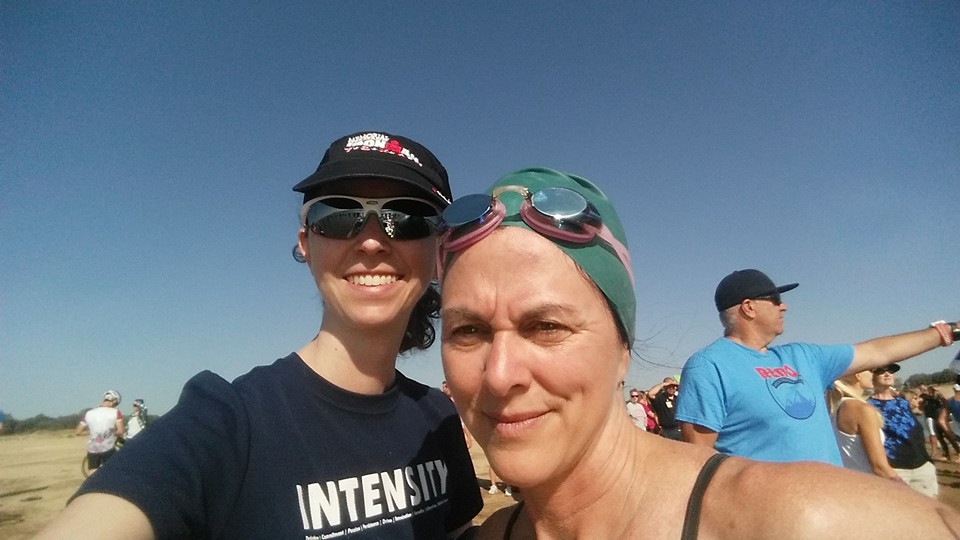
My Mom's First Triathlon
Reprinted from Deborah AdairThis is my mom's blog post on her first triathlon.
Swim, Bike ... RUN
The medic was pouring ice cold water over me, barely even waiting for my permission. In a reversal of roles, my daughter Kelsey was hovering, telling me to go sit down in the shade. She told me later that I had looked pretty bad.
Only the afternoon before, when I announced to my husband (a nationally ranked Ironman) that I was going to race, I was mostly joking. But somehow after the words came out of my mouth, they became a decision. It was the afternoon before The 19thAnnual Granite Bay Triathlon, a sprint distance triathlon: .75-mile swim, 13-mile bike, 5-mile run. I knew that the bike would be no problem, but I swim only occasionally just 50 laps of a sparkling clean pool. And I don’t run.
So I sorted through my clothing options. An old one-piece bathing suit and scratched up goggles, a pair of bike shorts with minimal padding. My shoes that only ever see the inside of the gym. And my Rudy Project glasses. Those were essential. Kelsey offered to loan me a running visor, which I refused because I don’t usually run with a hat. I don’t run.
My husband reminded me that I don’t run. I really don’t. In fact, I hate running. I told him that all of that time on the boring elliptical trainer at the gym has got to count toward something. And to prove my point, I put on my shoes and ran a mile around the neighborhood. See? I can run!
The good thing about deciding the day before is that there wasn’t a lot of time for nerves to get in my way. My friend Kirby was racing for the first time also, and he doesn’t swim or bike. But he’s Kirby. Part of my motivation to race is to honor my daughter Kelsey. This race is hosted by TBF Racing. Kelsey is like some type of legend or best friend with these people. She has raced and won and volunteered and cheered with TBF for several years, and everyone out there knows and loves her. But right now, she is debilitated from Crohn’s Disease. She had gotten up out of bed that morning to cheer for Kirby and me. She mustered a happy face through her pain and discomfort. And all of her TBF friends were happy to see her out there. And around TBF I am known as Kelsey’s mom.
At the start of the race, the announcer asked how many people were racing for the first time. Quite a few of us raised our hands. I felt better, less of an imposter. Then we were off!! Another newbie and I had decided to start at the back of the heap. I thought through what little I knew about open-water swimming. Kelsey’s advice the night before was to alternate breathing right to left. And in between look ahead. That sounded reasonable, but when I swim at my gym. I have a side to hold onto whenever I want to stop and rest. In the lake there’s no side and no bottom to stand on. And this water was not sparkling clean. As I swam, I heard the woman behind me (yes, behind me) gasping. The monitor on the kayak instinctively followed alongside her. I stopped and reminded her that he was there, but she stubbornly refused to stop to hang on. I couldn’t see the buoy, so I followed the feet in front of me and tried not to get kicked. The only other swimming tip that I could recall was that in triathlon, you swim with your arms and save your legs for the run. I kept trying to remind myself to save my legs, but when I was as far away from shore as I’ve ever been in my life, I was also thinking that I really wanted to make it back safely, and I didn’t want to hang onto the kayak.
At last the gooey shore was under my feet, and I ran through the swim finish. I high-fived the new girl who had started with me, as we got out of the water at the same time. The lake was low, so we had about ½-mile to trudge up the hill to get to our bike transition. I decided against running back to transition, thinking that I’d better save my legs for the run.
At bike transition I realized there were some details of triathlon I’d wished I had learned ahead of time. My feet were covered in sand, and now it was time to put on socks. I wished I’d packed extra water to clean them off. I brushed them off the best I could with my towel, got into my bike gear, had some water and a handful of peanuts and headed out. I’m not going to say that the bike was easy. It was relatively uneventful. I did drop my chain (which has been an annoying issue lately). And I learned something very interesting. One of the bicyclists stopped and asked if I needed help. How nice and unexpected that offer was! I was fine. I didn’t need help, but it was encouraging that he genuinely wanted to help. The one bit of bike advice I knew was to “spin.” Keep your bike in a lower gear and save your legs for the run.
On these sprint distance triathlons, you see all different shapes, sizes, and abilities. I have a pretty decent bike. There were plenty of cruiser bikes and racers with sneakers. I even saw some pedals with straps. Of course plenty of people were in it for the competition, but I’d say that most, like me, were in it for the experience. Ok, I’ll confess, I did make a point to power past a couple people on the bike.
Triathlon is a cruel sport. They make you do the worst thing last. Running. I don’t run.
I had already decided to run in my bike shorts and bathing suit. I know that I did not make much of a fashion statement, but it was the best choice with practically no time to prepare. And I did, after all, have my Rudy Projects. So all I had to do at the second transition was hang my bike on the rack and change shoes. Oh yes, take off the helmet. I only remembered that because of how many times Kelsey had mentioned it before the race. Take off the helmet.
I started off the run at a walk. Yes, I didn’t even run onto the course. I wanted to actually drink the water and Gatorade that were handed to me rather than wear them. I figured that I could probably run a mile before needing to walk. After all, I had proven to my husband just the night before that I could run a mile. And so I started to run. I planned to run to the 1-mile marker. Trail running is a lot different than the running that I don’t do in my neighborhood. It’s bumpy. And hilly. And hot. Well, maybe I wouldn’t run the whole first mile. I’d run most of it and then walk. Well, maybe I’ll run a little and walk a little. After a few rounds of running and walking, I hit the 1-mile marker. Really? Only a mile?? Maybe they hadn’t measured that one very well. Maybe I should have gone to the bathroom before I ran. But it’s only 5 miles. I’ll be fine.
As the run course went past the park area, I took one more look at the bathrooms. These were clean. I don’t want to stop at a porta potty. But, no, I’ll be fine, I thought. It’s less than 4 more miles. By this time, my cycles of running were becoming shorter, and walking was becoming longer. I was saving my legs for the last 2 miles.
There were people handing out water and more Gatorade. Kelsey had told me to stay hydrated, so I took both. At least I tried to. An issue with my spine makes it difficult for me to grab things with my right hand, so that first cup of Gatorade ended up spilling down my front. The volunteers handed me another. I drank the Gatorade and most of the water. I was sure there’d be another bathroom. I poured the rest of my water down my shoulders to cool down. I was hot. That hat would have been nice to have.
In triathlon, even though it’s a race, everyone is very supportive. The racers and staff and volunteers all want to see you accomplish your goals. My friend Nanc was volunteering by holding back traffic at an intersection. I made sure that I was running when I passed her. She called out to me, “Good job, Deborah.” I waved at her happily, appreciating her encouragement. As soon as I’d passed by, I was back to a walk. I was saving my legs for that last mile.
It’s amazing how much farther each mile looks on hills and dirt than it does in my neighborhood. Fewer and fewer people were behind me know. I wondered a couple times if there was anyone at all. I kept going, thinking that right around the corner, it would get easier and that maybe there’d be a portapotty.
Finally, I reach the last turnaround. There was Mark Davis, a TBF staffer cheering me on. He recognized me with “You’re Kelsey’s person” and followed along for several yards while detailing the remainder of the course. There was Nanc again. Waving and encouraging. I did not bother to smile or pretend to run. I waved back, but not the friendly kind of wave. I was saving my legs and my energy for the last ½ mile.
At last the bumpy trail smoothed out, and soon I was on the straightaway, the parking lot. This I should be able to run. But here was the bathroom. Yes! I would make a stop at the bathroom and then run the rest of the way in.
And so I did. The announcer said my name, and my husband and Kelsey and Kirby were all there waiting for me. And so was the medic. Apparently, I did not look too good when I got there, but I cooled down quickly. Kirby had finished a full 30 minutes before me. But he’s Kirby.
And so ended my first and ONLY triathlon. I finished. I was not last. But so many of my friends have offered their congratulations. People are talking about my accomplishment. I was congratulated again on Monday at the gym.
I’ll need to start running.

Wednesday, June 22, 2016
My Support Crew
Look at the people around you at your next race. You will see a teacher, a doctor, a firefighter, student, a salesman, a cashier, a lifelong athlete, first-time athlete, a single parent, a grandparent, a veteran, a cancer survivor, someone with a chronic illness, someone grief-stricken with loss of a loved one, a mom, a dad, a brother, a sister. The list goes on and on. Who do you really see? Your support crew. Your triathlon family. Everyone you see around you getting ready for this race has a different story. Everyone has a different background. Everyone is trying to get to the finish line. We're all in this race together.
 Looking back on the past year and a half, I have come to realize that I am incredibly lucky to have such a great support system. My family is going through this just as much as I am. They can't feel the physical pain, but they see it. They can feel the emotional pain. They've been there for me to take care of me. Whenever I have shared or talked about my experiences with friends, they've all been there for me. I was really excited to be able to represent my new (starting in 2015) sponsor Rudy Project at USAT Nationals last year. I was looking forward to meeting them in person at their booth at the race expo because they have been so nice to me. When I realized that I could not go to Nationals because I was sick, I dreaded making the phone call because I felt guilty for not being there when Rudy Project has been so great to me and fun to represent (with fabulous sunglasses and helmets). When I talked to them, they told me to take care of my health first. It is truly amazing to be able to work with such a great company and to know that they are supportive.

One of the things that I absolutely love about triathlon, and the endurance community in general, is the people, the spirit, and the camaraderie. Athletes are always so supportive of each other. Triathlon is a great way to meet incredible people and amazing friends. When athletes pass each other, you will always hear "good job," or "keep up the good work," "looking good," etc. When athletes have flats, mechanicals, injuries, or whatever, there will always be other athletes and support asking to help.
I have been fortunate to have experienced a lot of these positives in my life. Being diagnosed with any chronic illness is life changing. I have always been the type of person who thought that I could control everything. I have learned that I can't. I felt so isolated- as if no one could possibly know what I was going through. I felt guilty for being an inconvenience. I felt guilty for not following through with my dreams in triathlon and school. I felt guilty for being slow with my responsibilities and school work. I convinced myself that I must have done something wrong in my life, and I even asked my mom if I killed a box of puppies or something terrible when I was a kid. I knew that it somehow had to be my fault. I felt worthless. I felt like a failure. I kept wondering if all of this was real or if I was imagining the whole thing (Parts of the manifestations of the 5 stages of grief...)
Ulcerative Colitis is one of those things that a lot of people don't like to talk about because a lot of the symptoms are embarrassing or taboo to talk about socially. It is something that others cannot see on the outside, so many people decide to hide how they feel. If it weren't for already having this blog, I probably would not have talked about my disease either. But I've already shared a lot about my triathlon journey, and health is most definitely relevant to triathlon.
 Looking back on the past year and a half, I have come to realize that I am incredibly lucky to have such a great support system. My family is going through this just as much as I am. They can't feel the physical pain, but they see it. They can feel the emotional pain. They've been there for me to take care of me. Whenever I have shared or talked about my experiences with friends, they've all been there for me. I was really excited to be able to represent my new (starting in 2015) sponsor Rudy Project at USAT Nationals last year. I was looking forward to meeting them in person at their booth at the race expo because they have been so nice to me. When I realized that I could not go to Nationals because I was sick, I dreaded making the phone call because I felt guilty for not being there when Rudy Project has been so great to me and fun to represent (with fabulous sunglasses and helmets). When I talked to them, they told me to take care of my health first. It is truly amazing to be able to work with such a great company and to know that they are supportive.
I just wanted to take the time to say thank you to everyone who has been there for me. Thank you to my family and friends who have taken care of me. Thank you for giving me injections (because I don't like needles). Thank you for driving me around when I needed help. Thank you for listening to and reading about all of my goings on. Thank you for learning about ulcerative colitis and asking questions about what I'm dealing with. Thank you for sharing your class notes. Thank you for feeding my cat and taking care of my tree. Thank you for welcoming me with open arms when I am training or hanging out (special shoutout to my Total Intensity Sports peeps). Thank you to Rudy Project for your support (I will race again! Hopefully in the next couple of months!) Thank you to everyone who has stepped up for me. I am so grateful that I have all of you in my life.
I think there is an innate fear when you are perceived as "different" or going through a rough patch. I felt terrible things about myself because I was sick. No one else did. I was the one who was not feeling supportive of me. I was the one judging myself. All of you have been on my side. I know that I have not given up on my dreams. They are still there waiting for me. And I will keep going.
When you do sign up for your next triathlon (or really with anything you're doing), just remember: you are not alone. Everyone around you has dealt with some kind of challenge. Everyone you see around you is on your team. You will get to the finish line. Just keep swimming like Dory says. I feel as if this is an appropriate place to end how Ellen Degeneres finishes each show: Be kind to one another.

Oh, and just to add an extra note: don't take life for granted. I know it sounds cheesy in writing, but you really never know when your life is going to change. Find something that you enjoy. Find your dream job. Join a new club. Challenge yourself. If you've never done a triathlon before, go do one. It's fun. And like I said, the people are great.
Friday, May 20, 2016
World IBD Awareness Day
This is not my normal type of post, but today is World IBD Awareness Day. So I'm going to make you all aware. A lot of this is very personal and typically considered TMI in society, but whatever. I've been pretty open already because it has affected my life and training so much. Most of the information here is what I've read over the past year and my own personal experiences. There is a lot of good information at www.ccfa.org, Please bear in mind, this is a blog, not a lit review or scientific paper.
IBD stands for Inflammatory Bowel Disease, which includes Crohn's Disease and Ulcerative Colitis. IBD is essentially an auto-immune disease in the gut that is caused by a combination of factors including genetics, environment, and microbiota in the gut. The exact cause is unknown. The two diseases differ in that Chron's can affect the entire gastrointestinal tract, but Ulcerative Colitis is found in the colon and rectum. These disease are quite serious. It's not just "going to the bathroom" more than normal. If left untreated, it can be fatal. The symptoms can range in severity, and people have different responses to treatment, so experiences with the disease may be very different.
 My symptoms began in January 2015 (although there were some issues a few months before that that resolved and I chalked it up to a stomach bug...). I was going to the bathroom way too many times and not having normal, formed stool. I assumed it was stress because of crazy school things that I'm not going into detail in, so I ignored it for a month. When I started noticing occasional blood, that's when I knew I had to go get it checked out. I saw my PA, who was great. She ran through a bunch of tests (celiac, parasites, communicable GI diseases, and an occult blood test). Everything was negative except the occult blood. So I repeated that and it was again positive. She immediately got me a referral to a gastroenterologist. During this time, I started experiencing cramping, but it seemed to be directly correlated with the intensity of my workouts. I had to stop several times when the pain got bad. Even during our trip to Disneyland, the pain was increasing and we were just going from one bathroom to the next in between rides. I had a colonoscopy and was diagnosed with Ulcerative colitis.
So I've pretty much shared how my triathlon season was affected by this already. The month before Nationals, I was really sick, but I kept trying to convince myself that I was fine. We had already been trying anti-inflammatory medications (mesalamine) in various forms (enema, suppository, oral) with zero improvement. Symptomatically I was getting worse. We tried a couple doses of Prednisone and Flagyl (that stuff is horrid) to no avail. I was bleeding a lot and going to the bathroom a lot and the pain was unbearable most of the time (my parents took me to the ER 3 times before I moved). I kept trying to train and convince myself that I was fine. I wanted to go to Nationals. I wasn't fine, and deep down, I knew it. The week before Nationals, we decided to try IV steroids, which meant staying in the hospital. I was devastated.
I still wasn't improving, so we went tried a biologic, Simponi (this one is a TNFalpha blocker). Two months after the hospital stay, I was still getting worse and began vomiting a lot. This led to more ER visits. I had C. diff. Apparently Ulcerative Colitis makes you more prone to C. diff. That plus hospitals and steroids are like the perfect storm. Still no improvement, so we tried a different biologic. C. diff. is a terrible bacteria that us becoming increasingly antibiotic resistant. For me, it caused nausea and pain so severe that I wished I were dead.

 And then, C. diff again. I knew right away when I almost passed out in the shower after vomiting a lot at school. I was in so much pain I crawled to bed and my parents made me call an ambulance. No one even believed me (except my parents) when I said it felt like the last time I had C. diff. I ended up going to the ER twice the week before practicals and tests at the end of the semester. My GI put me on antibiotics pretty much right away just in case while we awaited results (another positive). It took a month to start to feel better. I got a rescue cat, Briar Rose, but she really rescued me. She knows when I don't feel well. She's a snuggler. A few months later, I had C. diff for a third time. My dad put the camping mattress in the bathroom for me to sleep on with my cat.
We made the decision to do a fecal transplant to prevent C. diff from coming back. I had to drive all the way to Reno from Sacramento (and mommy had to drive me the day of the procedure). The good news is, I feel so much better already. The bad news is, a lot of my symptoms are still there. The pain has reduced to just occasional cramping rather than lying on the floor curled up in a ball. So I'm thankful for that. I've also been able to start training more and even worked up to a 50 mile bike ride! But the reality is, with symptoms still having a major negative impact, that means that the current biologic treatment has not been successful, so now we have to try something else. I'm going to take the victories that I can, and I'm planning on racing next month at Folsom International and/or Tri for Real #2. After all that has happened, I know that I'm not as fast as I used to be. Speed isn't the point triathlon. Accomplishing new goals is the point. And having fun. That's always the point.


 Oh and of course, IBD doesn't just affect the patient. It affects family. It affects friends. It affects everyone. So thank you to everyone who has been supportive. Especially to my parents who have been there every step of the way.
Now you're all aware.
IBD stands for Inflammatory Bowel Disease, which includes Crohn's Disease and Ulcerative Colitis. IBD is essentially an auto-immune disease in the gut that is caused by a combination of factors including genetics, environment, and microbiota in the gut. The exact cause is unknown. The two diseases differ in that Chron's can affect the entire gastrointestinal tract, but Ulcerative Colitis is found in the colon and rectum. These disease are quite serious. It's not just "going to the bathroom" more than normal. If left untreated, it can be fatal. The symptoms can range in severity, and people have different responses to treatment, so experiences with the disease may be very different.
 My symptoms began in January 2015 (although there were some issues a few months before that that resolved and I chalked it up to a stomach bug...). I was going to the bathroom way too many times and not having normal, formed stool. I assumed it was stress because of crazy school things that I'm not going into detail in, so I ignored it for a month. When I started noticing occasional blood, that's when I knew I had to go get it checked out. I saw my PA, who was great. She ran through a bunch of tests (celiac, parasites, communicable GI diseases, and an occult blood test). Everything was negative except the occult blood. So I repeated that and it was again positive. She immediately got me a referral to a gastroenterologist. During this time, I started experiencing cramping, but it seemed to be directly correlated with the intensity of my workouts. I had to stop several times when the pain got bad. Even during our trip to Disneyland, the pain was increasing and we were just going from one bathroom to the next in between rides. I had a colonoscopy and was diagnosed with Ulcerative colitis.
So I've pretty much shared how my triathlon season was affected by this already. The month before Nationals, I was really sick, but I kept trying to convince myself that I was fine. We had already been trying anti-inflammatory medications (mesalamine) in various forms (enema, suppository, oral) with zero improvement. Symptomatically I was getting worse. We tried a couple doses of Prednisone and Flagyl (that stuff is horrid) to no avail. I was bleeding a lot and going to the bathroom a lot and the pain was unbearable most of the time (my parents took me to the ER 3 times before I moved). I kept trying to train and convince myself that I was fine. I wanted to go to Nationals. I wasn't fine, and deep down, I knew it. The week before Nationals, we decided to try IV steroids, which meant staying in the hospital. I was devastated.
I still wasn't improving, so we went tried a biologic, Simponi (this one is a TNFalpha blocker). Two months after the hospital stay, I was still getting worse and began vomiting a lot. This led to more ER visits. I had C. diff. Apparently Ulcerative Colitis makes you more prone to C. diff. That plus hospitals and steroids are like the perfect storm. Still no improvement, so we tried a different biologic. C. diff. is a terrible bacteria that us becoming increasingly antibiotic resistant. For me, it caused nausea and pain so severe that I wished I were dead.

 And then, C. diff again. I knew right away when I almost passed out in the shower after vomiting a lot at school. I was in so much pain I crawled to bed and my parents made me call an ambulance. No one even believed me (except my parents) when I said it felt like the last time I had C. diff. I ended up going to the ER twice the week before practicals and tests at the end of the semester. My GI put me on antibiotics pretty much right away just in case while we awaited results (another positive). It took a month to start to feel better. I got a rescue cat, Briar Rose, but she really rescued me. She knows when I don't feel well. She's a snuggler. A few months later, I had C. diff for a third time. My dad put the camping mattress in the bathroom for me to sleep on with my cat.
We made the decision to do a fecal transplant to prevent C. diff from coming back. I had to drive all the way to Reno from Sacramento (and mommy had to drive me the day of the procedure). The good news is, I feel so much better already. The bad news is, a lot of my symptoms are still there. The pain has reduced to just occasional cramping rather than lying on the floor curled up in a ball. So I'm thankful for that. I've also been able to start training more and even worked up to a 50 mile bike ride! But the reality is, with symptoms still having a major negative impact, that means that the current biologic treatment has not been successful, so now we have to try something else. I'm going to take the victories that I can, and I'm planning on racing next month at Folsom International and/or Tri for Real #2. After all that has happened, I know that I'm not as fast as I used to be. Speed isn't the point triathlon. Accomplishing new goals is the point. And having fun. That's always the point.


Now you're all aware.
Sunday, March 6, 2016
This hill is steeper than it used to be
Those were my thoughts as I was climbing one of the hills on the River Mountain Trail. No one else was around. Not even a roadrunner was in sight in the surrounding dusty hills. From the empty parking lot, there was not much of a warm-up before hitting the hill. My lungs were already burning and my heart was pounding only five minutes into my ride as I started to climb. The last time I had been on this trail was at the end of July as I was preparing for Nationals. I was at least thankful for the 70 degree January day as opposed to the 110 degree July heat.
Last year, after not being able to go to Nationals, I kept thinking I would be able to race at Silverman 70.3 and salvage my season. That turned out to not be a possibility. After weeks of nausea, vomiting, and a lost appetite I found out that I had C. diff (which is apparently common with UC, especially with the treatments I've been on). My parents took turns coming to take care of me and trying to get me to school as much as possible. I had to let the season go. When I eventually got over that, I ended up having a relapse a month later and was basically knocked out the rest of the year when I wanted nothing more than to start off-season strength training. Even walking around the block was a challenge.
Starting to train from nothing is a lot harder than staying in shape and keeping up with a routine (remember that if you are falling off the wagon). I have fallen so far from where I was. Every time I think about what I'm not able to do it's hard not to cry. When I swim, it is difficult to hold back tears, but I don't want to fog up my goggles. I'm frustrated that I'm not where I used to be and worried about the unknown. I need to focus on climbing back up, not on falling down. I need to congratulate myself each time I make it a little further, or a little faster. Personally, I like to celebrate with cookies. And I still reward myself with a quarter in my Kona jar because every workout counts.
The trick to starting a new workout routine, or coming back from illness or injury is really learning how to balance everything. You need to push yourself while not overdoing it. My very first workout this year was an 18 minute swim. I was tired after the first few minutes, but I was able to keep pushing. I was done at 18. There is a difference between "tired" and "done" and "oh no, I did too much." Each time you can make it to "done," you know that you are getting stronger and faster, and your endurance is building. Every time your workouts improve, you should acknowledge it. Be proud of what you can do and how far you've come. Eventually, you will get to where you want to be.
I have had to make a lot of adjustments, which is not an easy task for someone who likes to plan everything. Coach told me last season that it is okay to deviate from my schedule. Go hard on the days that you can, and take it easier when your body is telling you to. There are still a lot of unknowns. I'm going to do what I can, and that's really all that I can ask of myself.
Last year, after not being able to go to Nationals, I kept thinking I would be able to race at Silverman 70.3 and salvage my season. That turned out to not be a possibility. After weeks of nausea, vomiting, and a lost appetite I found out that I had C. diff (which is apparently common with UC, especially with the treatments I've been on). My parents took turns coming to take care of me and trying to get me to school as much as possible. I had to let the season go. When I eventually got over that, I ended up having a relapse a month later and was basically knocked out the rest of the year when I wanted nothing more than to start off-season strength training. Even walking around the block was a challenge.
Starting to train from nothing is a lot harder than staying in shape and keeping up with a routine (remember that if you are falling off the wagon). I have fallen so far from where I was. Every time I think about what I'm not able to do it's hard not to cry. When I swim, it is difficult to hold back tears, but I don't want to fog up my goggles. I'm frustrated that I'm not where I used to be and worried about the unknown. I need to focus on climbing back up, not on falling down. I need to congratulate myself each time I make it a little further, or a little faster. Personally, I like to celebrate with cookies. And I still reward myself with a quarter in my Kona jar because every workout counts.
The trick to starting a new workout routine, or coming back from illness or injury is really learning how to balance everything. You need to push yourself while not overdoing it. My very first workout this year was an 18 minute swim. I was tired after the first few minutes, but I was able to keep pushing. I was done at 18. There is a difference between "tired" and "done" and "oh no, I did too much." Each time you can make it to "done," you know that you are getting stronger and faster, and your endurance is building. Every time your workouts improve, you should acknowledge it. Be proud of what you can do and how far you've come. Eventually, you will get to where you want to be.
I have had to make a lot of adjustments, which is not an easy task for someone who likes to plan everything. Coach told me last season that it is okay to deviate from my schedule. Go hard on the days that you can, and take it easier when your body is telling you to. There are still a lot of unknowns. I'm going to do what I can, and that's really all that I can ask of myself.
Sunday, September 13, 2015
Starting Over
I know it has been a long time since my last post. I have not fallen off the face of the earth. I'm still around. I have had to take some time off from triathlon due to ulcerative colitis (in case you didn't read the last post). I've already committed to sharing the good, bad and ugly of my triathlon adventure, but I will spare the messy details. You're welcome.
I guess the good thing about having my season so rudely interrupted is that it's so hot in Henderson, NV (yes, I moved) that the triathlon season is just now starting. As long as I can get healthy, I can have a do-over for 2015 and squeeze in a couple races.

One of the most important things that you have to remember is that you have to take care of your body. Triathlon is great exercise and it's a lot of fun. But there may come a time when you need to stop and take a break. Your health comes first. Knowing when to call it isn't easy, but you need to be safe and healthy.
I spent the summer training as much as I possibly could for Nationals and Silverman 70.3. My summer training did not go as planned. I could not put in the volume or the effort that I would normally spend on training. The pain was getting worse and I had no idea how many calories I was actually absorbing. I had to learn to re-plan my workouts, which is really hard for someone like me who likes to schedule and plan everything. If I had a good day, I would train hard. If I was too sick, I either did a lighter training session, or had to take the day off. It was difficult mentally to cut a workout short. I had to learn to focus on the success of the workouts that I was able to complete and try to let go of the ones that I could not.
I was really excited for the Tri for Real series since I have made huge improvements over the past few years. I was coming off of a good race in Auburn that built my confidence, and I really wanted to PR. I was not well the day before, but I tried to convince myself that I could race anyway. I hadn't kept enough food in the day before or that morning. I knew it was a bad idea to race, but I went out there, and got set up. It was not until my warm-up that I was really honest with myself. I knew at that point that if I started that race, I would not finish. I ended up withdrawing. I cried when I got home, but it was the right decision. The next month, I was able to have a great race at the second Tri for Real, coming in second overall and only 2 minutes off my PR. I was really excited about this comeback, and I couldn't wait to go to Nationals.
Everything came to a screeching halt at the end of July. I was not absorbing enough calories or water no matter how hard I tried. I was down 12 pounds by this point. There were several days where it was a challenge just getting off the couch to go to the bathroom. I didn't want to give up on Nationals, but my good training days were dwindling and I couldn't maintain a healthy weight for triathlon. I was worried that I wasn't going to be able to race, but I wasn't ready to admit it. I was eventually told that I needed to think about getting IV steroids. As an athlete, my first thought was a defiant, "Okay, I'll think about it after Nationals." But the reasonable, future doctor part of the brain kicked in and decided that it was time to stop. My bike was lonely all boxed up and ready to go to Milwaukee, but it had to sit in my living room by itself instead while I went to the hospital to get some steroids.
 Now comes the starting over. In my mind, I was still planning on doing Silverman 70.3. I thought I was going to break out of the hospital all ready to go and start training again. It didn't happen quite like that, unfortunately. I'm still not really at a true "starting over" point since I'm still not in remission. I keep thinking I'll just wake up and feel fine again. My alarm clock is set for 5:00 A.M. every day just in case that is the day that it will all go away so I can train as usual. Most of the time it hasn't happened. It's gut wrenching when I realize that I can't workout. I know how hard everyone else is training and I want to be there, too. I want nothing more than to throw on my running shoes and post on Facebook about my amazing brick workout. But it isn't happening. I feel as if I'm lazy or not tough enough, or just full of excuses. What is a triathlete to do without triathlon? Studying Biochemistry at 5:00 in the morning is just a sad way to start the day. My bike isn't the only one feeling lonely.
I'm planning on doing Austin 70.3 with an Olympic distance a couple weeks before. I don't know how the next two months are going to go (it currently it hasn't been good), but I'm planning for the best, and taking it day-by-day. I am going to have to be smart about training by listening to my body and monitoring my food intake more than ever before. Hopefully my do-over will come. Otherwise, there's still next year.
Train smart and have fun. You only have one body. Take care of it. Enjoy the time that you have to do what you love because you don't know if or when things are going to change. Take advantage of the good days.
My parents definitely get a huge thank you for being by my side and taking care of me through all of this. Thank you for all of your love and support.

I guess the good thing about having my season so rudely interrupted is that it's so hot in Henderson, NV (yes, I moved) that the triathlon season is just now starting. As long as I can get healthy, I can have a do-over for 2015 and squeeze in a couple races.

One of the most important things that you have to remember is that you have to take care of your body. Triathlon is great exercise and it's a lot of fun. But there may come a time when you need to stop and take a break. Your health comes first. Knowing when to call it isn't easy, but you need to be safe and healthy.
I spent the summer training as much as I possibly could for Nationals and Silverman 70.3. My summer training did not go as planned. I could not put in the volume or the effort that I would normally spend on training. The pain was getting worse and I had no idea how many calories I was actually absorbing. I had to learn to re-plan my workouts, which is really hard for someone like me who likes to schedule and plan everything. If I had a good day, I would train hard. If I was too sick, I either did a lighter training session, or had to take the day off. It was difficult mentally to cut a workout short. I had to learn to focus on the success of the workouts that I was able to complete and try to let go of the ones that I could not.
I was really excited for the Tri for Real series since I have made huge improvements over the past few years. I was coming off of a good race in Auburn that built my confidence, and I really wanted to PR. I was not well the day before, but I tried to convince myself that I could race anyway. I hadn't kept enough food in the day before or that morning. I knew it was a bad idea to race, but I went out there, and got set up. It was not until my warm-up that I was really honest with myself. I knew at that point that if I started that race, I would not finish. I ended up withdrawing. I cried when I got home, but it was the right decision. The next month, I was able to have a great race at the second Tri for Real, coming in second overall and only 2 minutes off my PR. I was really excited about this comeback, and I couldn't wait to go to Nationals.
Everything came to a screeching halt at the end of July. I was not absorbing enough calories or water no matter how hard I tried. I was down 12 pounds by this point. There were several days where it was a challenge just getting off the couch to go to the bathroom. I didn't want to give up on Nationals, but my good training days were dwindling and I couldn't maintain a healthy weight for triathlon. I was worried that I wasn't going to be able to race, but I wasn't ready to admit it. I was eventually told that I needed to think about getting IV steroids. As an athlete, my first thought was a defiant, "Okay, I'll think about it after Nationals." But the reasonable, future doctor part of the brain kicked in and decided that it was time to stop. My bike was lonely all boxed up and ready to go to Milwaukee, but it had to sit in my living room by itself instead while I went to the hospital to get some steroids.
 Now comes the starting over. In my mind, I was still planning on doing Silverman 70.3. I thought I was going to break out of the hospital all ready to go and start training again. It didn't happen quite like that, unfortunately. I'm still not really at a true "starting over" point since I'm still not in remission. I keep thinking I'll just wake up and feel fine again. My alarm clock is set for 5:00 A.M. every day just in case that is the day that it will all go away so I can train as usual. Most of the time it hasn't happened. It's gut wrenching when I realize that I can't workout. I know how hard everyone else is training and I want to be there, too. I want nothing more than to throw on my running shoes and post on Facebook about my amazing brick workout. But it isn't happening. I feel as if I'm lazy or not tough enough, or just full of excuses. What is a triathlete to do without triathlon? Studying Biochemistry at 5:00 in the morning is just a sad way to start the day. My bike isn't the only one feeling lonely.
I'm planning on doing Austin 70.3 with an Olympic distance a couple weeks before. I don't know how the next two months are going to go (it currently it hasn't been good), but I'm planning for the best, and taking it day-by-day. I am going to have to be smart about training by listening to my body and monitoring my food intake more than ever before. Hopefully my do-over will come. Otherwise, there's still next year.
Train smart and have fun. You only have one body. Take care of it. Enjoy the time that you have to do what you love because you don't know if or when things are going to change. Take advantage of the good days.
My parents definitely get a huge thank you for being by my side and taking care of me through all of this. Thank you for all of your love and support.

Tuesday, May 26, 2015
Auburn International Triathlon Race Report
As I mentioned in my last post, I really wanted to get through this race and finish. It is a challenging course. I'm not where I want to be with training because of the recently diagnosed ulcerative colitis. My only goals for this race were to finish and work as hard as I could. I am really happy that I accomplished this. It was a huge mental boost for me to know that I can get through this race, especially considering that just a week before the race I couldn't move because the abdominal pain had been so intense, and the neck injury that I've been dealing with had worsened.
The swim was interesting to say the least. There were three different distances- World's Toughest Half (WTH), International, and Mini. WTH had the furthest swim at 1.2 miles, so they had yellow buoys to mark their turns. Ours was 1.5K (0.9 miles). We had orange buoys. The swim out was uneventful. The water was perfectly comfortable temperature-wise. I felt as if I had a good pace and was sighting well for the first two buoys. After the second buoy, we were looking straight into the sun. There were no sighting buoys (that was my one criticism of the course if any). I had absolutely no idea where the next buoy was. I swam towards where I thought we were supposed to go. I was alone. I finally saw an orange buoy and started swimming toward it. As I got closer, I realized that it was the start buoy. The Mini race was starting. I could now see the turn buoy way off to my right and turned toward it. The Mini swim course went straight to the buoy that I was now headed toward. Now I had an extra pack of swimmers to go through. As I got to the turn buoy, there was another crowd of the WTH athletes. It was bunched up from there to the end of the swim, but I was able to make it through unscathed and with a decent pace. The abdominal pain started becoming more noticeable about the last turn buoy, but I had to keep going. I thought I had lost a lot of time, but I heard the announcer call out Elsie Winter (They couldn't get Elise's name right haha) right ahead of me. I wasn't the only one who took the scenic swim route. Swim time was 25:31.
I got on the bike and started heading up the hill. The bike course for the international according to MapMyRide has 2,155 feet of climbing over 40 K. It's not easy. I'm glad I had a couple rides on the bike course because it was a technical course. You really have to know what gear to be in around each corner because every turn is followed by a hill- usually going up. I had everything planned down to when I would take my first Gu (right before Shirland Tract), which is one of the most difficult portions of the course. I saw someone with a dropped chain almost immediately after turning onto this street. There were chalk messages cheering on Jenni (who did WTH) and me on Shirland Tract (Total Intensity Sports peeps rock!). I laughed to myself when I saw "Yum hills" further up the hill. My dad went all over the bike course to cheer me on. I loved seeing him out there so much with his GoPro and cowbell. I saw the first men coming back a little bit after the aid station. I expected to see the first women several minutes later, but I did not until the last street- a couple minutes before the turn around. I was very relieved that I was not as far behind as I thought. Elise was out in front followed by a few others. Everyone seemed pretty close. I saw Coach John out on the course on my way back, and Mark a little while later. Heading into T2, I misjudged the hill right before transition. I was planning on a flying dismount, but it ended up being so slow and ungraceful that I ended up having to just get off the bike a little before the dismount line. Not one of my better moments, but good for a laugh. My bike time was 1:29:02.
I was expecting the 10K run course to be about the same level of difficulty as the run at Rancho Seco as far as elevation and trail difficulty go. There were some technical spots on the trails and a few hills. Nothing crazy, but I wouldn't call it easy. It took my legs about a mile on the run to start feeling good. The next mile or so I felt as if I was having a strong run. There was one section that veered off down a hill to an aid station where I saw Amber and Aimee volunteering and cheering. I'm really glad they were there because I really needed that boost! By about mile 3, the pain was really starting to intensify. It was tough, but I knew that I was going to get through this race. I just focused on my run stride, smile, and getting to the finish line. This is usually when I kick it into the next gear on the run to finish hard, but it wasn't there. I was able to maintain my pace and kept going as hard as I could. Because I did not preview the course, I did not realize that the second loop was shorter than the first loop. It was a very welcome surprise. I was spent when I crossed the finish line. My run time was 51:15. My final race time was 2:49:53, which was good for a 2nd place age group finish and 5th overall.
Congratulations to all of the athletes who raced this weekend. It's always fun to see everyone out there working hard and having fun. And congratulations to Elise (aka Elsie haha) on an awesome race and the overall win.
Thank you so much to my sponsor Rudy Project for helping make this all possible. This was my first race to try out the Wingspan helmet, and I love it! Thank you also to Coach John Pottebaum and my Total Intensity Sports teammates for getting me ready for this, especially with the extra unexpected challenges. Thank you to all of the volunteers, race staff, and friends who were out there supporting all of the athletes. And of course, thank you to my wonderful parents who have always been supportive of me and for taking care of me.
I am really looking forward to the rest of this season. After finishing this race, I know that I can push through and compete and I'm excited for some PRs. There is no quit. See you all at Tri for Real.
My sister's college graduation ceremony was the day before the race. I wasn't going to miss that for anything. I'm proud of her achievements and wanted to celebrate with her and my family. I ended up getting home way later than we expected, so I only got about 4 hours of sleep. But that's life.
On race morning, I was up at 3:30. The weather forecast was low 70s, which I think is cold, but comfortable enough. I know most people liked the temperature for racing. My dad spent the entire day as my personal support crew, for which I am very thankful. Sorry if some of this is TMI, but I'm sharing anyway. I ended up sleeping in the car on the way up since my meds make me uncomfortable in the morning, and my dad was nice enough to drive. We got to T2 to drop off my shoes, and I was surprised that there weren't more people up there. We drove down to T1 (as close as we could get in the car). I had to change what time I usually eat before the race (I've always eaten an hour before) because lately I have had to go to the bathroom almost exactly an hour after I eat anything. I didn't want to have to deal with that during the race, so I had to eat earlier. I know that seems like a silly thing to think about, but when we have our race day plans set up, we need to be prepared with every little detail, but be adaptable in case anything changes. I didn't have to run during the race, so mission accomplished.
It was awesome seeing so many of my friends getting ready, volunteering, and cheering. Before the race started, my coach told me to smile the whole race. I think this was the most important advice. It helped me not think about the pain and remember why I am out here. I race because it's fun. I enjoy pushing myself as hard as I can during training and racing, getting to the finish line, and reaching my goals.
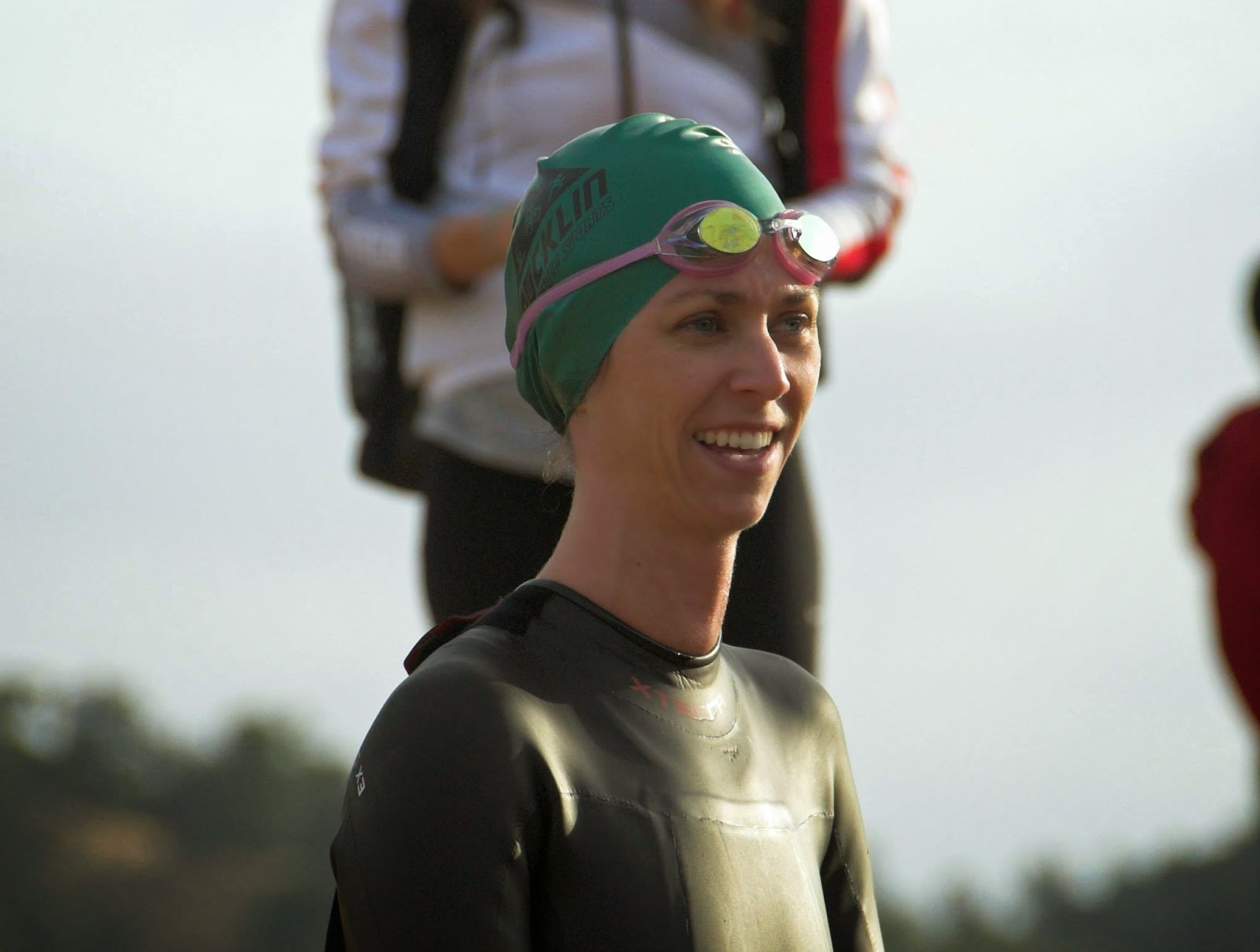 |
| Pre-swim start (Photo credit: Mark Davis) |
 |
| Coming out of the water (Facchino Photography) |
 |
| On the bike (Facchino Photography) |
 |
| Run Run (Facchino Photography) |
 |
| 25-29 F (Photo Credit: Daddy) |
Thank you so much to my sponsor Rudy Project for helping make this all possible. This was my first race to try out the Wingspan helmet, and I love it! Thank you also to Coach John Pottebaum and my Total Intensity Sports teammates for getting me ready for this, especially with the extra unexpected challenges. Thank you to all of the volunteers, race staff, and friends who were out there supporting all of the athletes. And of course, thank you to my wonderful parents who have always been supportive of me and for taking care of me.
I am really looking forward to the rest of this season. After finishing this race, I know that I can push through and compete and I'm excited for some PRs. There is no quit. See you all at Tri for Real.
Subscribe to:
Posts (Atom)